When your work involves national security, every email, calendar invite, and shared file carries a higher level of responsibility.
Government agencies, the U.S. Department of Defense, and the contractors who support them in defence, aerospace and intelligence operate under some of the strictest data security and compliance requirements in the world.
Sensitive designs, controlled technical data and confidential communications must be safeguarded at all times, with zero tolerance for exposure to unauthorised systems or personnel.
That’s why Microsoft offers Microsoft 365 Government, which includes GCC, GCC High, and DoD. In this article, we’ll explain what these government cloud environments are, who uses them, the compliance standards they support, the compatibility hurdles that often come with them, and how Door Tablet delivers a secure way to manage meeting rooms across all of these environments, whether deployed on-premises or in the cloud.
What Are Microsoft 365 GCC, GCC High and DoD and Who Are They For?
Microsoft 365 GCC (Government Community Cloud), GCC High, and Microsoft 365 DoD are specialised, highly secure Microsoft government cloud environments designed for organisations handling sensitive U.S. government and defence information.
Microsoft 365 GCC is designed for U.S. federal civilian agencies, state and local governments, tribal entities, and federal contractors who need to comply with government standards such as FedRAMP Moderate and CJIS without requiring the sovereign isolation of defense-tier clouds.
Microsoft 365 GCC High is intended for eligible U.S. government organisations and non-government entities such as Department of Defense contractors, aerospace and defence companies, intelligence community partners, and organisations handling Controlled Unclassified Information (CUI) or export-controlled data under ITAR (International Traffic in Arms Regulations).
Microsoft 365 DoD goes a step further. It is a highly restricted sovereign environment designed specifically for the U.S. Department of Defense and is available exclusively to eligible DoD entities, supporting workloads requiring compliance with the DoD Cloud Computing Security Requirements Guide up to Impact Level 5 (IL5).
For example, a municipal agency or state department might operate within GCC, a defence manufacturer or federal systems integrator handling CUI might use GCC High, while a U.S. Department of Defense service branch with IL5 requirements would operate inside Microsoft 365 DoD.
Unlike standard commercial Microsoft 365, all three environments provide data residency guarantees where customer content is stored at rest within the United States. For GCC High and DoD, Microsoft goes further into sovereign cloud isolation, where infrastructure is physically and logically segregated and backend access is strictly restricted to screened U.S. persons.
Why Do GCC, GCC High, and DoD Exist? (Compliance Matters)
For agencies, municipalities, and defense contractors handling public data, Controlled Unclassified Information, export-controlled data, or sensitive military communications, standard commercial cloud environments may not satisfy mandatory compliance frameworks.
Each tier addresses distinct regulatory thresholds:
-
FedRAMP Baselines: Microsoft 365 GCC meets FedRAMP Moderate, which satisfies requirements for the majority of civilian, state, and local government workloads. GCC High and DoD are assessed against NIST SP 800-53 controls at FedRAMP High (FIPS 199 High categorisation), providing a baseline tailored for high-impact federal and defense information.
-
DoD SRG Impact Levels: GCC supports DoD SRG Impact Level 2 (IL2). GCC High supports requirements up to DoD Impact Level 4 (IL4) (and select IL5 equivalents for Defense Industrial Base contractors). Microsoft 365 DoD provides the highest level of controls, purpose-built for DoD SRG Impact Level 5 (IL5).
-
DFARS 252.204-7012 / NIST SP 800-171: Defense contractors handling CUI must implement appropriate safeguards. While GCC covers certain baseline contractor requirements, GCC High is the industry-standard environment configured to satisfy full DFARS 7012 flow-down requirements, forensic reporting obligations, and NIST SP 800-171 controls.
-
ITAR and EAR: Export-controlled technical data under ITAR and EAR demands that data residency and access remain exclusively in the hands of vetted U.S. persons. Standard GCC does not support ITAR; GCC High and DoD were specifically built to satisfy these export-control standards.
-
CMMC (Cybersecurity Maturity Model Certification): For organizations across the Defense Industrial Base, GCC can support baseline requirements (such as Level 1 and select non-CUI scenarios), while GCC High is typically required for organizations seeking CMMC Level 2 certification where CUI and export-controlled data are present.
Together, GCC, GCC High, and DoD enable Microsoft 365 services, such as Exchange Online, Teams, SharePoint, and OneDrive, to operate safely within certified parameters matching each agency's or contractor's regulatory obligations.
Life in GCC, GCC High, and DoD: Common Tech Challenges
Operating in any Microsoft Government cloud provides essential security, but it also introduces practical administrative and architectural challenges. Because these environments prioritize isolation and compliance, not every third-party application or commercial feature works out of the box.
Microsoft services, features, and API updates often roll out to government tiers later than they do to the commercial cloud, and some consumer-facing features are disabled entirely to maintain security baselines.
For third-party software, an even bigger barrier is connectivity and endpoint architecture. While GCC shares aspects of the commercial directory infrastructure, GCC High and DoD operate on dedicated Microsoft Government cloud endpoints and separate Microsoft Entra ID (formerly Azure AD) identity instances. Third-party tools that are hardcoded solely for commercial Microsoft 365 endpoints will inevitably fail to authenticate or access calendar data when introduced to government tenants.
How Do Microsoft 365 Government Environments Integrate with Workspace Tools?
In a modern office, touchscreens mounted outside conference rooms display meeting availability, host names, and let staff book space on the fly. However, off-the-shelf room booking displays frequently rely on commercial cloud relays or third-party servers that cache calendar data, a practice that can violate government security frameworks or trigger connection errors due to unsupported government endpoints.
In GCC, GCC High, and DoD environments, workspace scheduling must respect government security boundaries:
- Meeting subject lines, attendee lists, and schedules must remain within the approved Microsoft 365 government tenancy.
- Room scheduling systems must authenticate directly against the correct cloud instance, whether connecting via standard Microsoft Graph endpoints for GCC, or dedicated sovereign endpoints for GCC High and DoD.
- Solutions that mandate sending calendar payloads through unvetted third-party cloud bridges are often disqualified during security and accreditation reviews.
How Door Tablet Bridges the Gap for Secure Room Booking
Door Tablet is a comprehensive meeting room and workspace scheduling solution that synchronises directly with your calendars to display schedules on touchscreen panels and interactive kiosks, designed with high-security environments in mind.
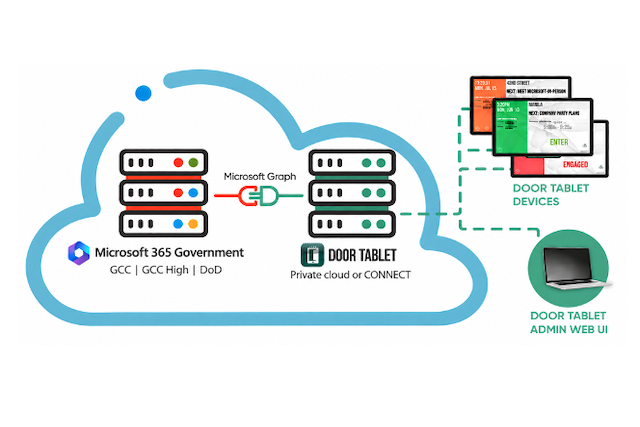
Door Tablet supports direct integration across Microsoft 365 GCC, GCC High, and DoD, allowing government agencies, defense contractors, and military facilities to connect securely to their Exchange Online calendars using the appropriate government cloud endpoints:
- No Unnecessary Third-Party Relays: Door Tablet communicates directly with your Microsoft 365 government tenant. Your sensitive meeting metadata never leaves your approved boundary to sit on an unaccredited vendor database.
- Support for Specific Endpoints: Door Tablet natively supports the specialized network and authentication services required by GCC, GCC High, and DoD.
- Modern Office Experience: Staff enjoy modern conveniences, checking room availability, booking ad-hoc meetings, and checking into rooms via digital signage, without compromising organizational compliance.
Flexible Deployment to Meet Your Security Needs
Every government agency, defence organisation or contractor has a unique IT setup and security posture. Recognising this, Door Tablet offers flexible deployment options to fit different requirements, whether you want everything in-house or prefer a cloud-hosted environment. Specifically, you can deploy Door Tablet in three ways:
-
Door Tablet CONNECT (Cloud Service): A shared, managed cloud server hosted by Door Tablet on AWS. While suitable for municipal or commercial deployments with less restrictive policies, organisations with strict GCC High or DoD compliance mandates often determine that a multi-tenant cloud is outside their accreditation boundaries.
-
On-Premises Server: For complete data sovereignty, you can deploy the Door Tablet server entirely within your own self-managed, on-premises infrastructure. All room configurations and calendar caches remain strictly within your local network, communicating securely outbound to your Microsoft 365 GCC, GCC High, or DoD tenant.
-
Private Cloud Instance: You can run a dedicated Door Tablet server within your organisation’s own controlled cloud tenant, such as Azure Government or AWS GovCloud. This delivers the convenience of cloud hosting while preserving dedicated single-tenant isolation for straightforward compliance assessment.
Conclusion
Navigating public sector and defense compliance is demanding, but Microsoft 365 GCC, GCC High, and DoD allow organisations of all tiers to adopt cloud collaboration without surrendering the security controls their missions require.
- GCC delivers a compliant baseline for federal civilian, state, and local agencies.
- GCC High protects Controlled Unclassified Information (CUI) and export-controlled data for defense contractors and government entities.
- DoD provides a dedicated, hardened environment for the U.S. Department of Defense supporting up to Impact Level 5.
Door Tablet’s native compatibility across all three tiers extends this protection directly to the walls outside your conference rooms. By interfacing natively with your designated Microsoft government cloud and offering true on-premises or private-cloud hosting, Door Tablet ensures your workplace management stays efficient, modern, and fully compliant.
Key Takeaways:
- Microsoft 365 GCC meets FedRAMP Moderate and CJIS standards for federal civilian, state, and local government bodies.
- Microsoft 365 GCC High provides FedRAMP High and ITAR-compliant sovereignty for defense contractors and organizations handling CUI.
- Microsoft 365 DoD is exclusively reserved for Department of Defense entities requiring DoD SRG Impact Level 5 controls.
- Room booking solutions must support specific Microsoft government authentication endpoints to function in these environments.
- Door Tablet integrates natively with GCC, GCC High, and DoD, offering on-premises and private cloud deployments that keep meeting data strictly within your accredited boundary.
We offer complete technical documentation on integrating Microsoft 365 GCC, GCC High, and DoD with Door Tablet. Create an account to access deployment guides and schedule a demo with our technical team.